Mike DiPetrillo
May 9, 2026 · 7 min read
Two Weeks, One Message: Critical Minerals and Sustainability Are Converging — and the Industry Knows It
From a main stage panel in Nice to an EU delegation in Phoenix, the same conversation kept showing up: the IT industry needs information and financial infrastructure for critical minerals and sustainability reporting. It doesn't have it yet.
I just spent two weeks crossing between Nice, France and Phoenix, Arizona — different continents, different audiences, different agendas. The same conversation showed up in every room.
Critical minerals and sustainability reporting are no longer parallel tracks. They're converging into a single problem, and the IT industry doesn't have the infrastructure to handle either one properly.
That's not a pitch. It's what I heard — repeatedly, unprompted — from ITADs, OEMs, policymakers, recyclers, academics, and EU officials across three events in fourteen days.
Nice: ITAD Europe and the Critical Minerals Panel
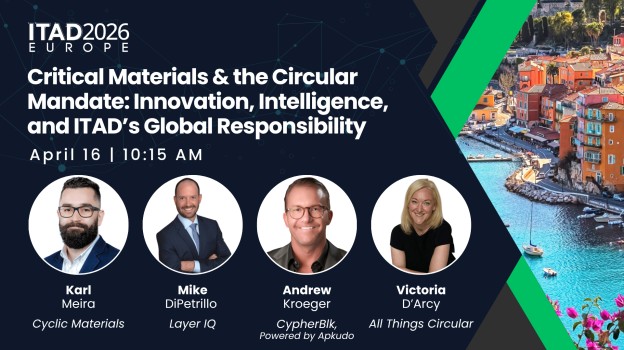
ITAD Europe brought 1,500 professionals to Nice on April 15–16. I was on a main stage panel alongside Karl Meira from Cyclic Materials and Victoria D'Arcy from All Things Circular, moderated by Andrew Kroeger. The topic was supposed to be about ITAD's evolving role. It turned into a conversation about national security.
Andrew's pre-event framing laid it out well: over the past decade, ITAD has moved from value recovery and disposition into something far more strategic — business continuity, supply chain resilience, critical materials recovery, data security, ESG accountability. That shift was palpable in the room.
Less than 1% of rare earths are currently recycled. China processes over 90% of the global supply. Every server, every hard drive sitting in an ITAD warehouse contains materials that are now a matter of supply chain resilience and, increasingly, national security. Karl Meira brought a perspective that most ITAD operators hadn't heard before. Cyclic Materials recovers rare earth elements from end-of-life IT equipment — hard disk drives, motors, magnets — using proprietary hydrometallurgical processes. The material is there and the process to recover it now exists at scale.
The audience response was visceral. ITADs have been processing this equipment for years without understanding what was inside it at the materials level. They knew the resale value. They knew the scrap value. They didn't know they were sitting on critical minerals that governments are now scrambling to secure domestically.
What struck me wasn't just the interest — it was the recognition. People weren't learning something abstract. They were realizing that the work they've been doing for years is suddenly strategic in a way that nobody had framed for them before.
Here's the thing: the companies in this space are doing great work. ITADs are getting the equipment. Cyclic Materials is recovering material that nobody else can reach. Recyclers are processing at scale. The problem isn't capability — it's data. An ITAD processing a pallet of servers today has no way to know what quantity of critical minerals is inside those assets, or what those materials are worth on commodity markets versus selling the unit whole or sending it for bulk scrap. The information rails connecting the people doing the work to the data they need to make better decisions — that's what's missing.
Phoenix: The CSCC and Building the Western Critical Corridor
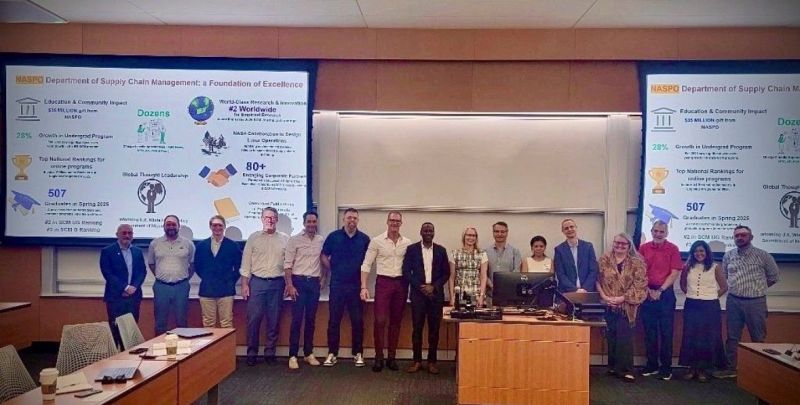
The very next week — Earth Day, actually — I was in Phoenix at Arizona State University's W. P. Carey School of Business for the inaugural session of the Circular Supply Chain Coalition (CSCC).
The room brought together Layer IQ, Cyclic Materials, Quick Ship Brands, CXtec, Advanced United Refining, and Pyxera Global — alongside ASU faculty, hyperscaler representatives, data center operators, semiconductor companies, and recyclers — to establish a circular IT hub in Phoenix.
The concept is the Western Critical Corridor — Arizona, Nevada, Utah, Idaho — as a proving ground for circular IT supply chains. Phoenix makes sense as the launchpad in a way that few other regions can match. ASU is ranked #1 in supply chain management, #1 in sustainability, and is consistently top-ranked in innovation. Phoenix is the second-largest data center market in the United States. Some of the largest ITADs in the country operate there. And the region is home to two of the largest hydrometallurgical processing plants in North America. Chip manufacturing, data center operations, materials recovery, academic research, and circular economy operators — all concentrated in one metro area. The coalition's thesis: you can build and test closed-loop systems here that demonstrate what's possible before scaling globally.
Josh Beasley from Quick Ship Brands put it well: "The CSCC is about execution. Aligning hyperscalers, data centers, semiconductors, academia, utilities, ITADs, and recyclers to build scalable, resilient circular systems."
That's exactly right. This wasn't a summit where people gave talks and went home. The session ended with working groups and commitments. People left with assignments.
What I noticed — and what matters for our industry — is that the same ecosystem that needs critical minerals recovery also needs sustainability reporting infrastructure. The OEMs supplying data centers need to know what happens to their equipment at end of use to report Scope 3 Category 12. The data center operators retiring that equipment need to know what happened with it to report Scope 3 Category 5. The semiconductor companies need the recovered raw materials back in their supply chain. These aren't separate problems for separate teams. They're the same problem, and they require the same underlying data infrastructure to solve.
Phoenix: The Circular Economy Forum and the EU Delegation
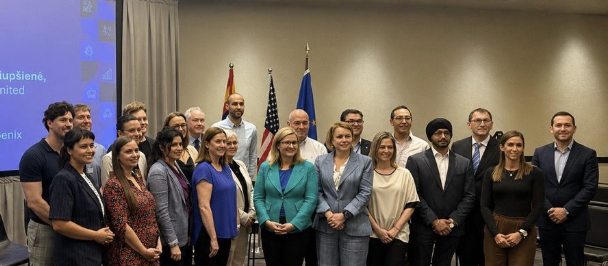
The very next day, the conversation moved from industry to policy. The Circular Economy Forum brought an EU delegation to Phoenix for a two-day event themed "Building a Resilient Future Together." Phoenix Mayor Kate Gallego, EU Ambassador Jovita Neliupšienė, and Governor Hobbs all spoke. The room included several EU ambassadors alongside sustainability and circularity leads from Intel, Microsoft, Heraeus, and Layer IQ.
This is where it got real. EU CSRD is creating reporting obligations for roughly 50,000 companies. California SB-253 covers another 4,000+. The GHG Protocol is tightening. And the EU Critical Raw Materials Act is mandating that 25% of rare earth supply come from recycling by 2030.
These aren't future problems. They're current obligations with approaching deadlines. And the companies subject to them — the OEMs, the enterprises, the financial institutions — are discovering that the data they need doesn't exist in any usable form.
The EU delegation wasn't there to talk theory. They were there because European policymakers understand that circular economy regulation without data infrastructure is just paperwork. You can mandate reporting, but if companies don't have the tools to generate accurate, activity-based data, you get estimates and averages — which is what most Scope 3 reporting consists of today.
The forum produced real outcomes. US and EU representatives signed agreements establishing the foundation for critical mineral recovery cooperation and expanded sustainability action between the two regions. This isn't directional language in a communiqué — it's binding framework that will drive procurement requirements, reporting standards, and recovery mandates in both markets.
What resonated from this event — and from every conversation across the two weeks — is that Layer IQ's mission to provide the information and financial infrastructure for circular IT isn't aspirational anymore. It's what every participant in the ecosystem is asking for. The ITADs in Nice were asking for materials intelligence. The coalition members in Phoenix were asking for data infrastructure. The policymakers at the forum were asking for verification tools.
The Throughline
Three events. Two continents. Fourteen days. Every room surfaced the same gap:
The IT industry generates enormous environmental and economic value when equipment is retired — carbon reduction, critical minerals, materials recovery, compliance data. But there's no platform connecting the organizations that need this intelligence: OEMs tracking end-of-life products, enterprises reporting Scope 3, ITADs routing assets, recyclers recovering materials, policymakers verifying claims.
That gap is what we're building Layer IQ to close. And after two weeks of hearing the same need expressed by 1,500 ITAD professionals in Nice, a cross-sector coalition in Phoenix, and an EU delegation meeting with Arizona's governor — I'm more certain than ever that the timing is right.
Next week I'm in Atlanta giving a keynote at UNEDA — the 300+ member alliance of used network equipment dealers who collectively move over $2 billion in pre-owned gear annually. Same topic. Same convergence. And we have a partnership announcement coming that puts the materials and environmental data foundation in place to act on all of it.
More on that Monday.
Mike DiPetrillo is CEO and Founder of Layer IQ.